
Hairdressing Salon Business Plan: A Practical Outline
On this page
- What goes into a hairdressing salon business plan
- Write your hair salon business description and business model
- Market analysis and a service menu that fits the clock
- Startup costs and your break-even point
- Capacity, bookings and no-shows
- Licenses, team and day-to-day operations
- A one-page hairdressing salon business plan to copy
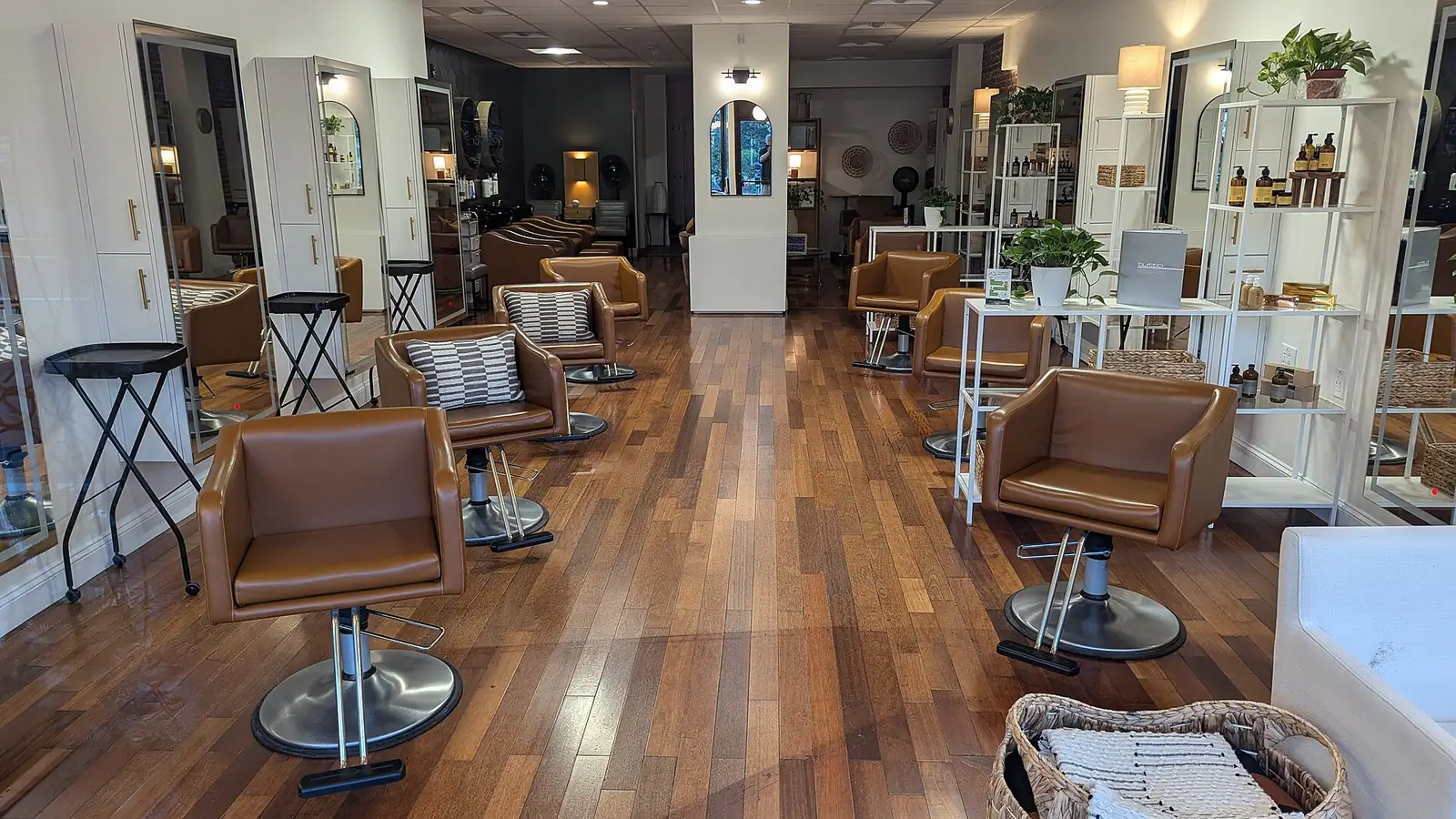
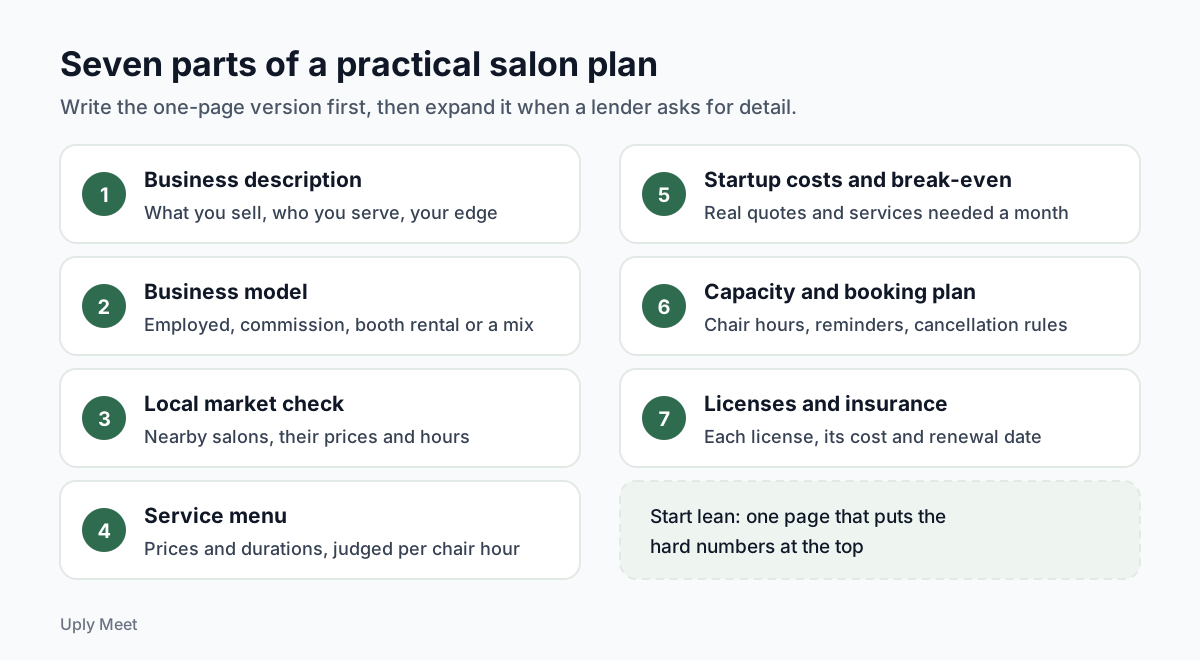
A hairdressing salon business plan is a short written document that says what your salon sells, who it serves, how the chairs will be filled each week and when the money covers the costs. For most new or small salons, a practical plan has seven parts: a business description, your business model, a local market check, a service menu with prices and durations, startup costs with a break-even point, a capacity and booking plan, and the licenses and insurance you need.
You do not need a 40-page document to start. Write a one-page version first, test the numbers, then expand it when a bank, landlord or partner asks for detail. This guide gives you the structure, a business description you can adapt, a worked break-even example and a one-page outline to copy.
What goes into a hairdressing salon business plan
The U.S. Small Business Administration describes two common formats in its guide to writing a business plan: a traditional plan, which "can be dozens of pages long", and a lean startup plan, which can "take as little as one hour to make" and is "typically only one page".
Our view: start lean. A hairdressing salon business plan lives or dies on a handful of numbers (chair hours, average ticket, rent, product cost), and a long document can hide a weak number on page 23. Expand to the traditional format only when someone who lends or invests money asks for it.
The standard sections, translated for a salon
The SBA lists nine common sections for a traditional plan. Here is what each one means for a hair salon in practice.
| Plan section | The salon question it answers |
|---|---|
| Executive summary | What is the salon, where is it, and why will clients choose it? |
| Company description | Which clients and services do you focus on (color, curly hair, bridal, family cuts)? |
| Market analysis | Who else cuts hair within a short drive, and what do they charge? |
| Organization and management | Who owns it, who manages the floor, which legal structure? |
| Service or product line | Your service menu, durations, prices and retail products. |
| Marketing and sales | How new clients find you and how they book. |
| Funding request | How much you need, and what it pays for. |
| Financial projections | Monthly revenue, costs and cash flow for the first year. |
| Appendix | Lease draft, licenses, quotes from suppliers, CVs. |
Who will read your plan
If you are borrowing, the plan is a sales document for a lender. The UK government's business plan page puts it plainly: "You'll need a business plan if you want to secure investment or a loan from a bank." If you are self-funding a two-chair studio, the plan is mostly for you, so honesty beats polish.
Write your hair salon business description and business model
The business description is the paragraph people actually read, so it should be specific. "A modern salon offering cuts and color" describes thousands of salons. Name the client, the speciality and the reason to choose you.
A business description you can adapt
Example only. Replace every bracket with your own details:
[Salon name] is a [number]-chair hairdressing salon in [neighborhood], opening in [month and year]. We specialize in [color correction / curly and textured hair / low-maintenance cuts for busy parents], for clients who [want appointments before or after office hours / travel from nearby towns for a specialist]. Clients book online at any hour, get an email reminder before each visit, and can move their own appointment without calling. The salon is owned by [name], a licensed stylist with [number] years of experience in [speciality].
Notice what is missing: words like "luxury", "passionate" and "one-stop shop". They cost nothing to write, which is exactly why lenders skim past them.
Choose a hair salon business model
How stylists are paid shapes every other number in the plan. According to the U.S. Bureau of Labor Statistics, hairdressers, hairstylists and cosmetologists held about 595,000 jobs in 2025 and 48% of them were self-employed, and some stylists "lease booth space from a salon owner". In other words, many of the people you might hire are used to working for themselves.
| Model | How the salon earns | Main risk for the owner |
|---|---|---|
| Employed stylists (wage) | All service revenue; you pay wages and payroll costs | Wages are due even when chairs sit empty |
| Commission | A share of each stylist's service revenue | Income swings with how busy each stylist is |
| Booth or chair rental | A fixed weekly or monthly rent per chair | Little control over hours, prices or the client experience |
| Owner-operator, solo | Everything you cut, minus your costs | No income when you are ill or on holiday |
Many salons mix models, for example the owner works a chair while renting two more. That is fine, as long as the plan shows each income line separately.
Market analysis and a service menu that fits the clock
A quick local market check
You do not need a paid market report. Spend one afternoon on the following and write the answers into the plan:
- List every salon and barbershop within the distance your clients will travel.
- Note their prices for a standard cut, a full color and a blow-dry.
- Check their opening hours. Evenings and Sundays are often under-served.
- Look at how they take bookings: phone only, a marketplace app, or their own booking page.
- Read their recent reviews for repeated complaints you can fix.
Price by chair time, not only by service
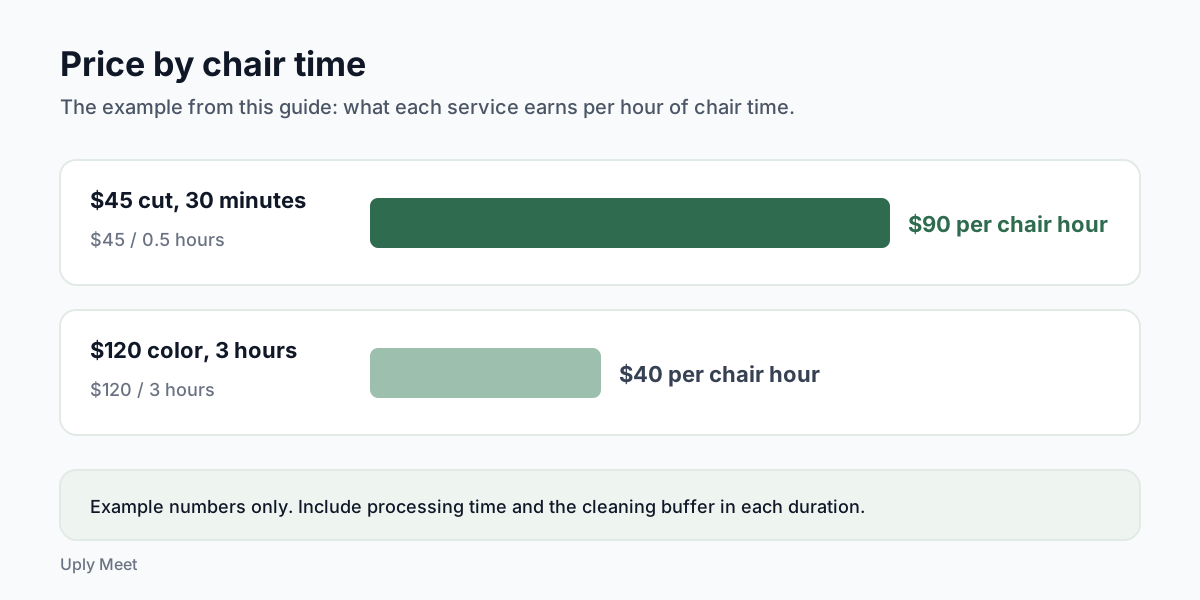
This is the point most templates skip. A chair is a fixed block of time, so every service should be judged by what it earns per hour of chair time. A $45 cut that takes 30 minutes earns more per hour than a $120 color that blocks the chair for three hours.
Write durations next to prices on your menu, including processing time and the buffer you need to clean the station. Those durations later feed your booking system, which then only offers slots that actually fit.
Startup costs and your break-even point
The SBA's startup cost guide lists costs almost every business faces, including space, equipment and supplies, licenses and permits, insurance, a lawyer and accountant, inventory, salaries, marketing and a website. For a hair salon, add fit-out and plumbing for backwash basins, styling chairs and stations, color stock and retail products.
We are not going to quote a typical cost to open a salon. It depends far too much on your city, the lease and whether the unit was a salon before. Get real quotes and put them in the appendix.
A worked break-even example
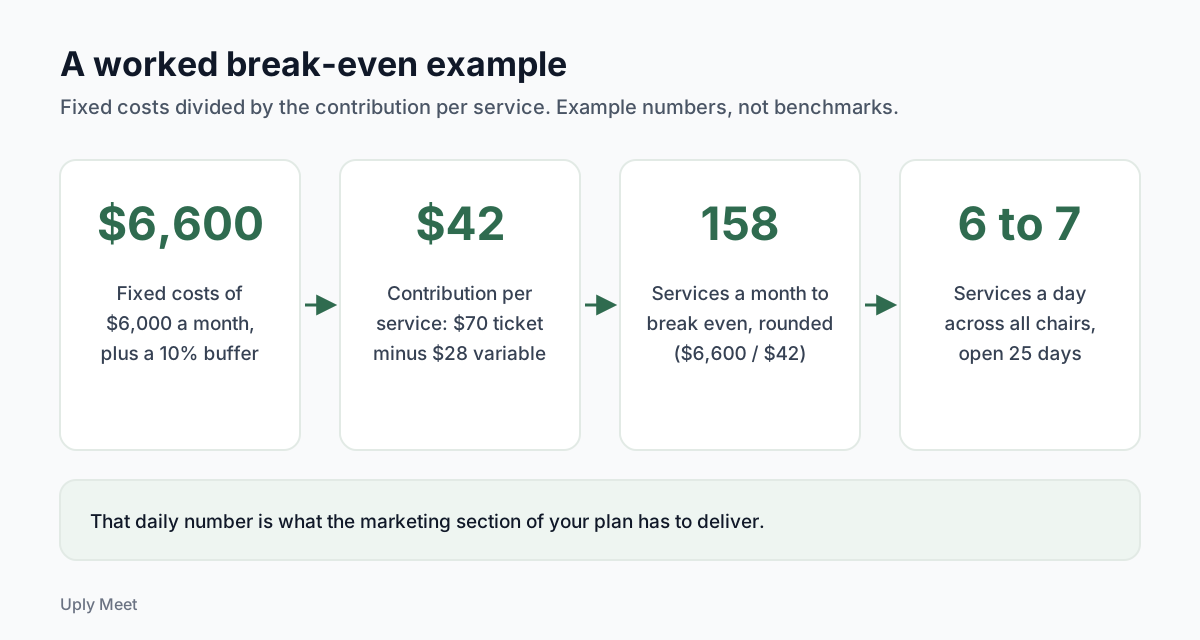
The SBA gives the formula: fixed costs divided by (price minus variable cost) equals the break-even point in units. It also suggests adding a little extra, "say 10%", for costs you cannot predict. You can run your own numbers in the SBA break-even calculator.
Example numbers only, to show the method. They are not benchmarks:
| Line | Example value |
|---|---|
| Monthly fixed costs (rent, insurance, software, utilities, loan) | $6,000 |
| Plus 10% buffer | $6,600 |
| Average service ticket | $70 |
| Variable cost per service (product, commission share) | $28 |
| Contribution per service ($70 minus $28) | $42 |
| Break-even ($6,600 divided by $42) | about 158 services per month |
Now sanity-check it against the calendar. If the salon opens 25 days a month, 158 services is about 6 or 7 a day across all chairs. That is the number the marketing section of your hairdressing salon business plan has to deliver, and it is far more useful than a revenue target pulled from thin air.
Capacity, bookings and no-shows
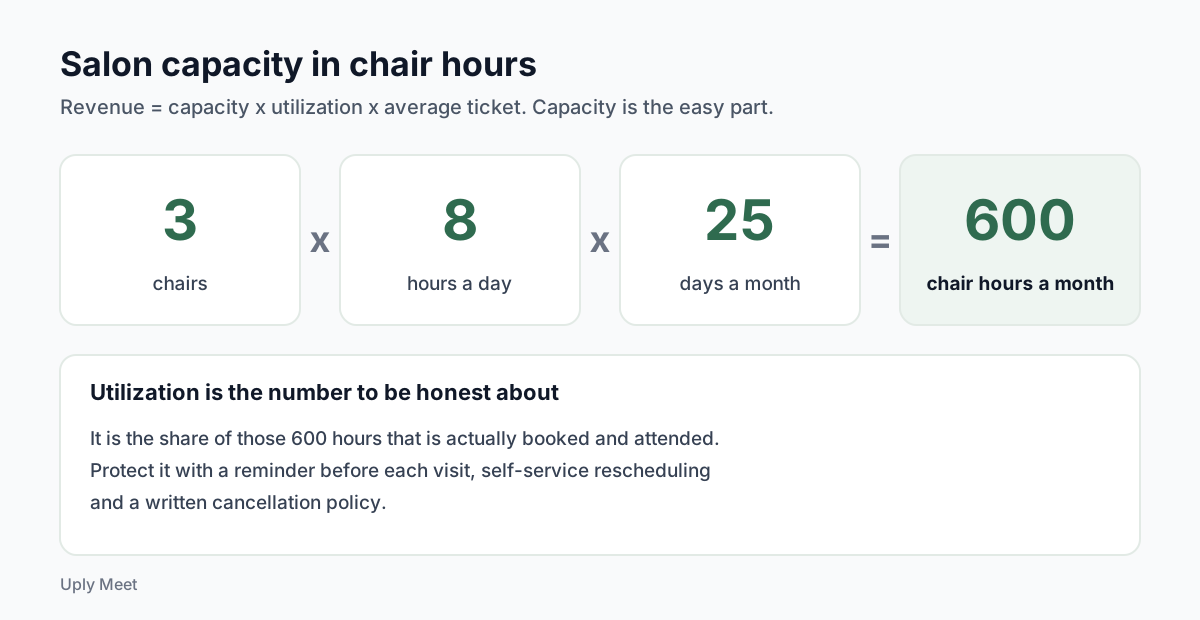
Revenue in a salon is capacity times utilization times average ticket. Capacity is easy to calculate: chairs multiplied by bookable hours. Three chairs open 8 hours a day for 25 days gives 600 chair hours a month. Utilization, the share of those hours actually booked and attended, is the number your plan should be honest about.
Write a booking plan
Describe how clients will book, how far ahead, and what happens when they need to change. Online appointment booking lets clients book at any hour, and every booking taken while you are cutting is one less phone call to return. Spell out working hours, breaks and days off for each stylist so the booking page cannot offer a slot nobody can serve.
Plan for no-shows from day one
A missed appointment is a chair hour you cannot sell twice. There is no reliable independent survey of salon no-show rates, so be careful with figures you see quoted online. The closest solid research comes from healthcare: a systematic review of 105 studies found an average no-show rate of about 23% in clinic appointment scheduling, and long lead times were among the most commonly reported factors. Salons are not clinics, but the lesson carries over: the further ahead someone books, the more a reminder matters.
Put three things in the plan: an appointment reminder before each visit, an easy way for clients to reschedule themselves, and a written cancellation policy. A short written policy helps here; our guide to setting a no show fee walks through the wording.
If part of your floor will run barbering services with shorter, busier slots, a dedicated barber app setup for those chairs can keep quick cuts from blocking long color appointments. If your chairs are mostly barbering, the barber shop business plan guide covers walk-ins and fade pricing in more depth.
Licenses, team and day-to-day operations
Licenses and insurance
Licensing rules depend on where you work, so check with your local or state licensing authority before you sign a lease. In the United States, the Bureau of Labor Statistics notes that "All states require barbers, hairstylists, and cosmetologists to be licensed." Ask your city or council whether the premises also needs its own permit or inspection. List each license, its cost and its renewal date in your hairdressing salon business plan.
Team and hiring
Show who does what: who manages the floor, who orders stock, who answers messages. In a two or three person salon these are often the same person, and the plan should admit that, because it explains why tools that save admin time are a real line item rather than a luxury.
Bookkeeping and monthly review
Keep sales, product costs and rent in one place from the first day. Accounting software such as QuickBooks or Xero works for hair salons, and so does a well-kept spreadsheet when you start small. Once a month, compare actual services and revenue with your break-even line, then update the plan. A business plan that never changes after opening day is a document, not a plan.
A one-page hairdressing salon business plan to copy
Example outline. Copy it into a document and keep each answer to two or three lines:
- Description: salon name, location, number of chairs, opening date, speciality, ideal client.
- Business model: employed, commission, booth rental or a mix, with the rate for each.
- Market: five nearby competitors, their prices, and the gap you fill.
- Service menu: each service with price, duration and revenue per chair hour.
- Startup costs: fit-out, equipment, first stock, deposits, licenses, insurance, website.
- Break-even: monthly fixed costs plus 10%, contribution per service, services needed per month and per day.
- Bookings: how clients book, reminders, reschedule and cancellation rules.
- Team and licenses: who does what, licenses held, renewal dates.
- Funding: how much you need, from where, and what it pays for.
For a longer version, free templates are easy to find; the UK's Start Up Loans business plan template and the SBA examples are solid starting points. Fill in the one-page hairdressing salon business plan first anyway. It forces the hard numbers to the top.
When you reach the bookings line, you can set up a free Uply Meet booking page with your services, durations and working hours, so the calendar in your plan is the same one clients book into. Plans and limits are on the Uply Meet pricing page.
Frequently asked questions
How long should a hairdressing salon business plan be?
For your own use, one page is enough to start, as long as it includes the service menu, startup costs and a break-even number. If you are applying for a loan, expect to expand it into a traditional plan with detailed financial projections, which the SBA notes can run to dozens of pages.
What is the difference between a hair salon business description and a business model?
The business description says what the salon is, where it is and who it serves. The business model says how it makes money, for example employed stylists, commission, booth rental or a mix, and it drives most of the numbers in your financial section.
Do I need a business plan if I rent a booth or chair?
A shorter one, yes. A booth renter is effectively a small business: you still need to know your chair rent, product costs, how many clients a week you need to break even, and how clients will book and be reminded of appointments.
How do I estimate revenue for a new salon with no history?
Work from capacity: chairs multiplied by bookable hours gives your chair hours. Multiply by a cautious share of those hours you expect to fill, then by your average ticket. Compare that with your break-even point and adjust prices or hours until the plan works on cautious numbers.
Is there a free hairdressing salon business plan template?
Yes. The SBA publishes example business plans in both traditional and lean formats, and the UK government points to free templates from Start Up Loans and The King's Trust. The one-page outline in this article is also free to copy.
How do I calculate the break-even point for a hair salon?
Use the SBA formula: fixed costs divided by the price per service minus its variable cost. The SBA suggests adding about 10% for costs you cannot predict. In this guide's example, $6,600 divided by a $42 contribution gives about 158 services a month, or 6 to 7 a day over 25 open days. Those are example numbers, not benchmarks.
Should my salon use employed stylists, commission or booth rental?
It depends on the risk you can carry. With employed stylists, wages are due even when chairs sit empty. Commission income swings with how busy each stylist is. Booth rental gives a fixed rent per chair but little control over hours, prices or the client experience. Many salons mix models, as long as the plan shows each income line separately.
What licenses does a hair salon need?
It depends on where you work, so check with your local or state licensing authority before signing a lease. In the United States, the Bureau of Labor Statistics notes that all states require barbers, hairstylists and cosmetologists to be licensed, and your premises may need its own permit or inspection. List each license, its cost and its renewal date in the plan.
Sources
- U.S. Small Business Administration: Plan your business (write your business plan, calculate your startup costs)
- U.S. Small Business Administration: Break-even point calculator
- U.S. Bureau of Labor Statistics: Barbers, Hairstylists, and Cosmetologists (Occupational Outlook Handbook)
- GOV.UK: Write a business plan
- Start Up Loans: Business plan template
- Dantas et al. (2018), No-shows in appointment scheduling: a systematic literature review, Health Policy