
Barber Shop Business Plan: Sections, Costs and Template
On this page
A barber shop business plan is a written case for your shop: what you will offer, who will book, what it costs to open, how many cuts you need to break even, and how you will fill the chairs. Write it before you sign a lease or ask anyone for money. A clear plan helps you open a barber shop on numbers instead of hope.
This guide covers the sections a lender expects, a startup cost worksheet, simple chair math and a template you can copy. Every number that is not a placeholder links to its source.
What goes in a barber shop business plan
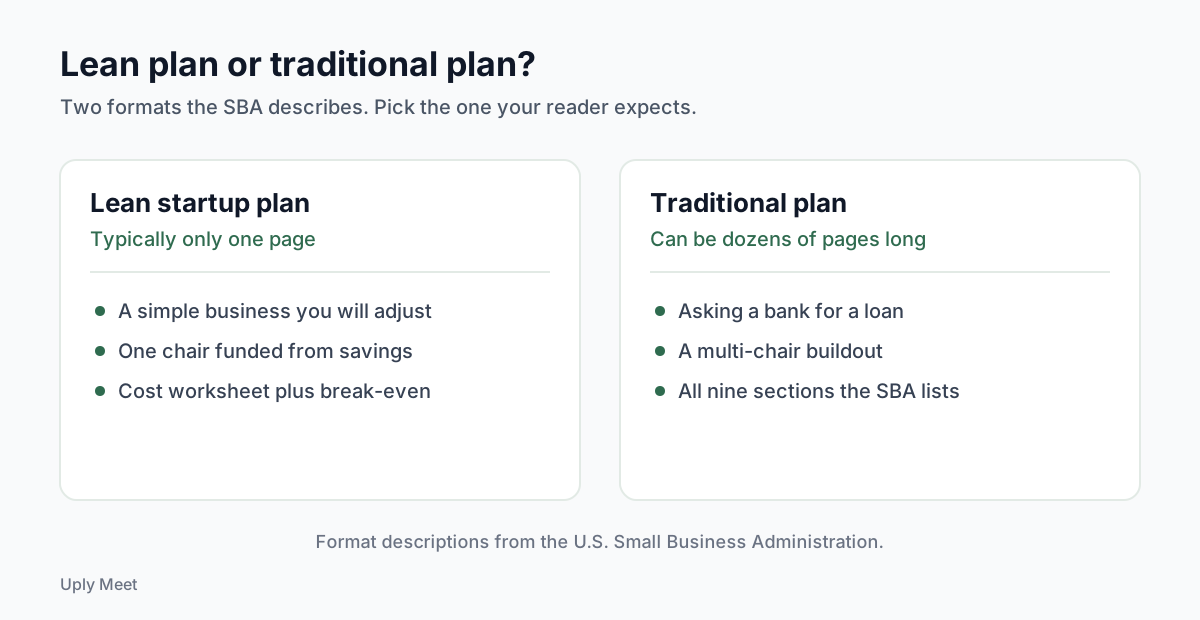
The U.S. Small Business Administration describes two formats. A traditional plan "can be dozens of pages long" and suits you if you plan to ask a bank for money. A lean startup plan is "typically only one page" and suits a simple business you expect to adjust as you go.
A one-chair shop funded from savings rarely needs forty pages. A three-chair buildout funded by a loan does. Pick the format your reader expects, then fill only the sections that matter to them.
Here are the nine sections the SBA lists for a traditional plan, translated into what a barbershop actually writes in each one.
| SBA section | What a barbershop writes there |
|---|---|
| Executive summary | The shop in one page: services, location, who runs it, how much money you need and why it will work. |
| Company description | The problem you solve for local clients (wait times, quality, hours) and your edge, such as a strong location or an experienced barber. |
| Market analysis | Who lives and works nearby, which shops they use now, what those shops charge and how busy they look on a Saturday. |
| Organization and management | Legal structure (sole proprietor, LLC and so on), who does what, and how barbers are paid. |
| Service line | Your menu: cuts, fades, beard trims, shaves, kids cuts, with a duration and a price for each. |
| Marketing and sales | How new clients find you and how a booking actually happens: walk-in, phone, online booking page or all three. |
| Funding request | How much you need, debt or equity, and exactly what it pays for (chairs, buildout, the first months of rent). |
| Financial projections | Monthly projections for year one and yearly for the next years, matched to the funding request. |
| Appendix | Licenses, the lease draft, equipment quotes and resumes. |
Which sections matter most for a barber shop business
Lenders read the summary first and the numbers second. Everything in between exists to make the numbers believable. That is why the rest of this guide spends most of its time on costs, chair capacity and break-even, which is where a generic barber shop business plan template is thinnest.
Market research and the pay model
Start with the size of the trade. According to the U.S. Bureau of Labor Statistics, barbers held about 75,800 jobs in 2025, and 80% of them were self-employed. BLS projects barber jobs to reach 78,300 by 2035, a 3% rise. So most people in this field already run some kind of barber business, even if it is one chair.
National numbers will not tell you whether your street needs another shop, though. For that, do the legwork yourself.
Study the shops near you
- List every barbershop within a short drive and note their prices for a standard cut and a beard trim.
- Check how far ahead they are booked on a weekday evening and on a Saturday morning.
- Note whether they take walk-ins, appointments or both, and how a client books.
- Read their public reviews for complaints you could fix, such as long waits or rushed cuts.
In our view, the gap you find here matters more than any national statistic. "Nobody nearby takes bookings after 6 pm" is a business plan. "The industry is growing" is not.
Pick a pay model: commission, booth rent or wages
BLS notes that some barbers "lease booth space from a salon owner". Your choice of model changes almost every number in the plan, so decide it early.
| Model | How money flows | What it means for the plan |
|---|---|---|
| Commission | The shop takes every payment and pays each barber a share. | Your revenue includes all services; barber pay is a variable cost that rises with sales. |
| Booth rent | Barbers pay you a fixed weekly or monthly rent and keep their own service income. | Your revenue is the rent; steady and predictable, but you control less (schedules, prices, client lists). |
| Hourly or salary | You pay a wage and keep the service income. | Wages are a fixed cost; slow weeks hurt more, busy weeks pay more. |
For a wage benchmark, BLS reports a median hourly wage for barbers of $18.37 in May 2025. Use local job ads to sanity check that number for your city.
Cost to start a barbershop: a worksheet
Here is an honest answer to "how much does it cost to open a barber shop": it depends on your city, your space and whether you buy new or used chairs. Rent and buildout alone can vary several times over from one neighborhood to another. We did not find a reliable national average, so we will not quote one. Treat any single "average cost" figure you see online with care.
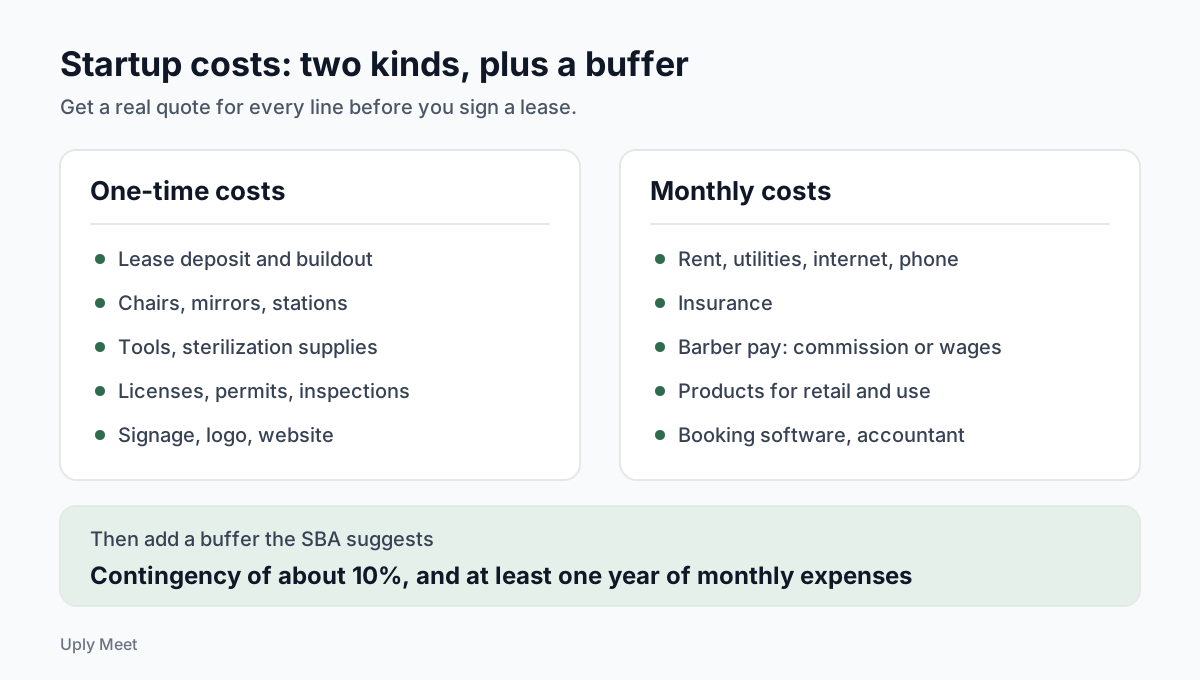
What you can do is list every cost and get real quotes. The SBA splits startup costs into one-time expenses and monthly expenses, and suggests counting "at least one year of monthly expenses". Fill in this worksheet with quotes from landlords, suppliers and your state board.
| Cost line | Type | Where the number comes from |
|---|---|---|
| Lease deposit and buildout (plumbing for wash stations, electrics, flooring) | One-time | Landlord and contractor quotes |
| Barber chairs, mirrors, stations, waiting seats | One-time | Supplier quotes, new and used |
| Clippers, trimmers, shears, razors, sterilization supplies | One-time, then monthly top-ups | Supplier price lists |
| Shop and barber licenses, permits, inspections | One-time, plus renewals | Your state board and city |
| Signage, logo, website | One-time | Designer and sign maker quotes |
| Rent | Monthly | Lease draft |
| Utilities, internet, phone | Monthly | Previous tenant bills or provider quotes |
| Insurance | Monthly or yearly | Broker quote |
| Barber pay (commission or wages) | Monthly | Your pay model above |
| Products for retail and use | Monthly | Distributor price lists |
| Booking and payments software | Monthly | Vendor pricing pages |
| Accountant, marketing | Monthly | Quotes |
Software is one line where prices are public, so you can fill it in today. When we checked on October 25, 2026, Square Appointments listed a $0 Free plan per location (it earns on card processing fees), Fresha listed $19.95 per month for one team member, and Booksy listed $29.99 per month plus $20 for each extra team member.
Marketplace fees can come on top: Fresha lists a 20% one-time commission (minimum $6) on new clients found through its marketplace, and Booksy's optional Boost charges 30% of a new client's first visit, up to $100.
Revenue math: chairs, capacity and break-even
Most templates ask you to "forecast revenue" and leave it there. A barbershop can do better, because its capacity is easy to count: chairs times hours, divided by service length.
Work out capacity per chair
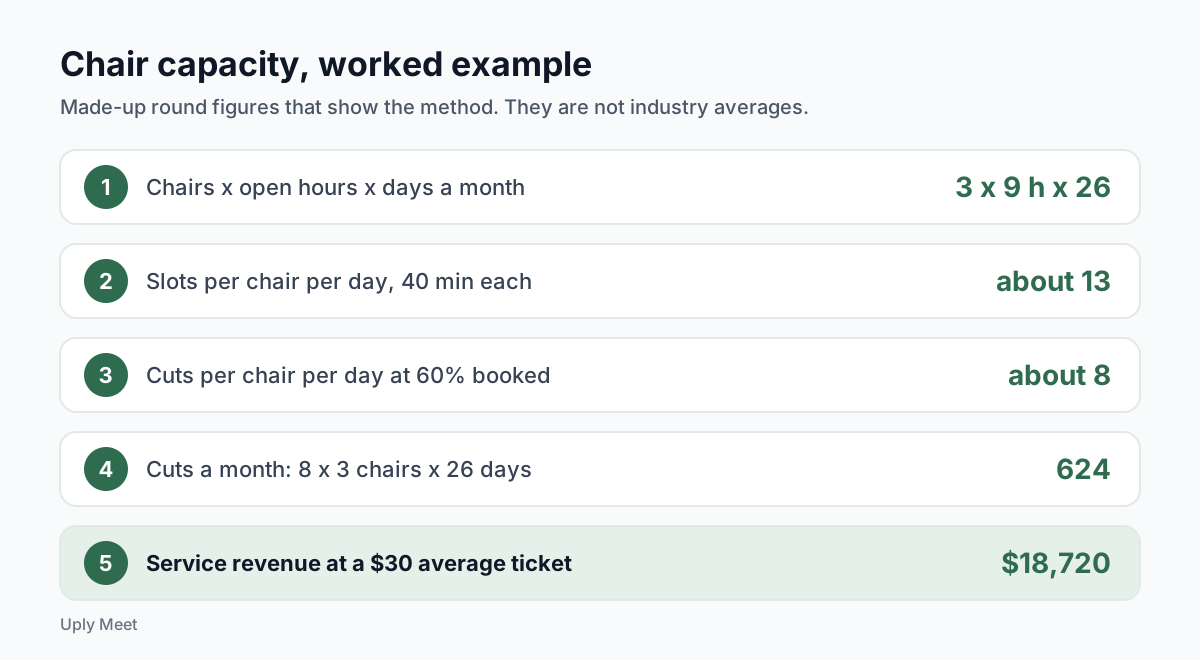
The numbers below are made-up round figures to show the method. They are not industry averages, so swap in your own.
- 3 chairs, open 9 hours a day, 26 days a month.
- 40 minutes per appointment, including cleanup: about 13 slots per chair per day.
- 60% of slots booked: about 8 cuts per chair per day.
- 8 cuts x 3 chairs x 26 days = 624 cuts a month.
- At an example average ticket of $30, that is $18,720 in monthly service revenue.
Find your break-even point
The SBA gives the formula: fixed costs divided by (price minus variable costs) equals the break-even point in units. In the example, say fixed costs (rent, insurance, utilities, software, loan payment) are $9,000 a month, and each cut carries $12 of variable cost (barber commission and supplies).
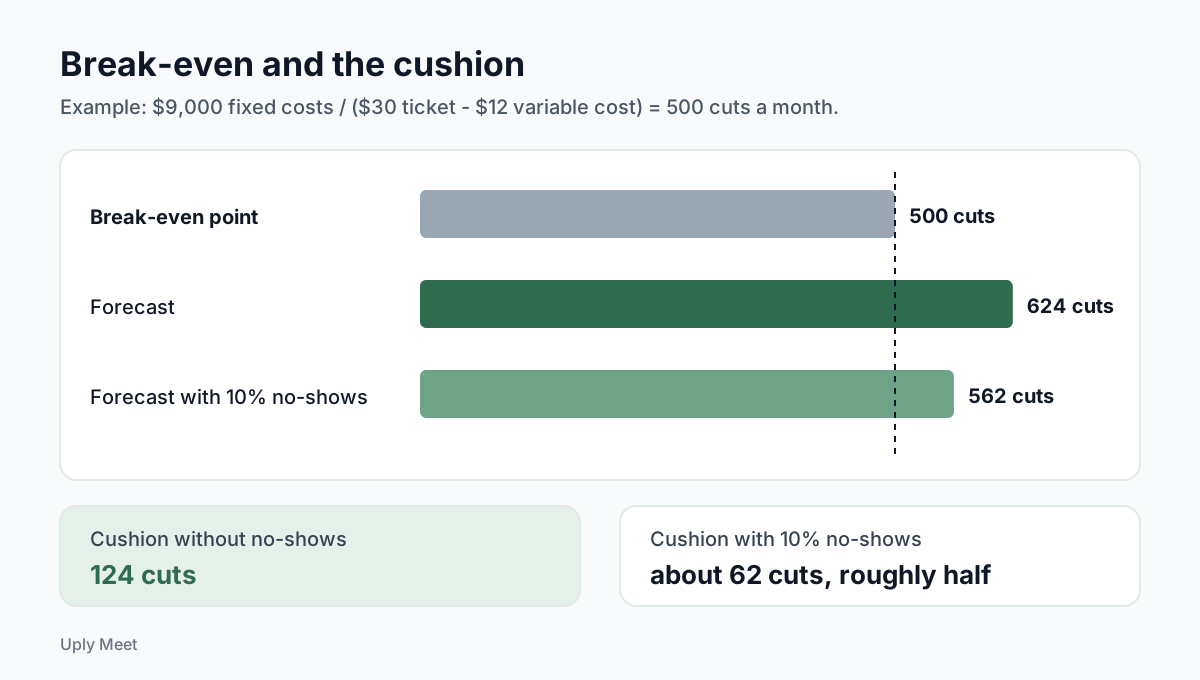
$9,000 / ($30 - $12) = 500 cuts a month. The example shop does 624, so it has a cushion of 124 cuts. That cushion is the most useful number in your whole plan, because it tells a lender how much can go wrong before you lose money.
Put no-shows into the forecast
Here is the line most plans leave out: booked is not the same as served. Barbershop no-show rates are not tracked in any study we could find. In healthcare, a systematic review of 105 studies put the average no-show rate at about 23%. Clinics are not barbershops, so do not copy that figure. Instead, test your plan with a few rates of your own.
In the example, if 10% of booked cuts never show, 624 becomes about 562. The shop still clears 500, but the cushion halves. That is why the next section treats reminders and a cancellation policy as part of the plan, not an afterthought.
Operations: licensing, booking and policies
Start with the legal side, because it can block your opening date. BLS states that all states require barbers to be licensed, usually after a state-approved program and an exam. Shop licenses, inspections and permits vary by state and city, so check with your state board early and list each one in the appendix.
Decide how clients book
Walk-ins keep chairs busy at peak times but make quiet hours unpredictable. Appointments make revenue easier to forecast and let you plan staff. Many shops mix both, for example appointments only after 5 pm. Write your choice into the marketing and sales section, because it shapes your whole week.
Whatever mix you choose, give clients a link they can book from without calling. Clients should see your services, prices and open times, and pick a slot that cannot be double booked. A dedicated barber app does this for a shop. A general appointment booking page works if you only need a simple link for your bio and Google profile.
Reminders and a cancellation policy
In healthcare research, a meta-analysis of 21 studies found that more than one reminder worked better than a single one. Those studies tested text messages at clinics, not barbershops, so treat it as a hint, not a promise. An appointment reminder the day before and a few hours before is a reasonable default. Pair it with a short policy clients see before they book. Here is an example you can adapt:
Example policy: Need to move or cancel? Please do it at least 24 hours before your appointment using the link in your confirmation email. Late arrivals of more than 15 minutes may need to rebook.
For the barber shop business plan itself, one sentence is enough: how far ahead clients can book, how they change a booking, and what happens after a no-show.
A barber shop business plan template you can copy
Copy this outline into a document and answer each prompt in a few sentences. It follows the SBA sections above. The figures in brackets are placeholders for your own numbers.
- Executive summary. Shop name, address, opening date. Services and price range. Owner background. Funding needed: [amount] for [uses].
- Company description. The local gap you fill. Your advantage: location, skills, hours or booking convenience.
- Market analysis. Nearby shops and their prices. Who your clients are and where they work or live.
- Organization. Legal structure. Number of barbers. Pay model: commission, booth rent or wages.
- Services. Menu with duration and price per service.
- Marketing and booking. How clients find you (Google profile, social, referrals) and how they book (walk-in, online link, phone).
- Funding request. Amount, debt or equity, and a line-by-line use of funds.
- Financials. Startup cost worksheet, chair capacity, monthly forecast for year one, break-even and the cushion.
- Appendix. Licenses, lease draft, quotes, resumes.
Things needed to start a barber shop: a short checklist
- Barber license and any shop license or permit your state and city require.
- A lease you have read with an adviser.
- Equipment quotes and a delivery date before opening day.
- Insurance in place before the first client sits down.
- A booking link, a cancellation policy and a reminder routine.
- A simple way to track bookings, no-shows and revenue each month, so the next version of your plan uses real numbers.
Uply Meet is one option for that last part: the Free plan covers one barber and 100 online bookings a month with email reminders 24 hours and 2 hours before each visit. Whatever you choose, plan the booking flow before you plan the decor. A beautiful empty chair still costs rent.
Frequently asked questions
How long should a barber shop business plan be?
As long as your reader needs. The SBA describes a lean plan as typically one page and a traditional plan as up to dozens of pages. If you are asking a bank for a loan, use the traditional format; if you are funding a one-chair start yourself, a one-page plan with a cost worksheet and break-even is often enough.
How much does it cost to open a barber shop?
There is no reliable single figure, because rent, buildout and equipment vary widely by city and by whether you buy new or used. List every one-time and monthly cost, get quotes for each, add a contingency of about 10% as the SBA suggests, and budget at least a year of monthly expenses.
Do I need a license to open a barber shop?
In the United States, BLS states that all states require barbers to be licensed, usually after a state-approved program and an exam. Many states and cities also require a shop license, permits or inspections, so check with your state board of barbering before you sign a lease.
Is booth rent or commission better for a new barber shop owner?
Neither is better for everyone. Booth rent gives you predictable income but less control over prices and schedules. Commission gives you all service revenue and more control, but your income moves with how busy the chairs are. Run your break-even with both models before you choose.
What barber business software do I need at the start?
At minimum, a booking link clients can use without calling, reminders before each appointment, and a calendar that prevents double bookings. Payments and point of sale can come from the same tool or a separate one. Compare monthly prices and any marketplace commission on new clients before you commit.
What sections should a barber shop business plan include?
The SBA lists nine sections for a traditional plan: executive summary, company description, market analysis, organization and management, service line, marketing and sales, funding request, financial projections and an appendix. For a barbershop, the costs, chair capacity and break-even carry the most weight.
How do I calculate the break-even point for a barber shop?
Use the SBA formula: fixed costs divided by (price minus variable cost per service). In the example in this guide, $9,000 / ($30 - $12) = 500 cuts a month. Compare that with your capacity forecast; the difference is your cushion.
Should a barber shop business plan account for no-shows?
Yes. Booked is not the same as served. Barbershop no-show rates are not tracked in any study we found, so test your forecast with a few rates of your own. In the example, 10% no-shows cut 624 cuts to about 562 and halve the cushion above break-even.
Sources
- U.S. Small Business Administration: Plan your business (business plan sections, startup costs, break-even point)
- U.S. Bureau of Labor Statistics: Barbers, Hairstylists, and Cosmetologists, Occupational Outlook Handbook
- Dantas et al., No-shows in appointment scheduling: a systematic literature review, Health Policy (2018)
- Robotham et al. (2016), Using digital notifications to improve attendance in clinic: systematic review and meta-analysis, BMJ Open
- Square Appointments pricing (checked October 25, 2026)
- Fresha pricing (checked October 25, 2026)
- Booksy pricing (checked October 25, 2026)