
How to Start and Run a Massage Business
On this page
A massage business runs on four things: a legal way to practise where you live, a service menu priced to cover your real costs, a booking and cancellation system clients can use without calling you, and a steady way to fill your calendar. Get those right before you buy the nice towels, and most of the other decisions get easier.
It is a growing field. The US Bureau of Labor Statistics counts about 155,400 massage therapist jobs in 2025, says 36% of them are self-employed, and projects employment to grow 15 percent from 2025 to 2035. The same page notes that therapists, especially self-employed ones, spend time "recording notes on clients, marketing, booking clients, and conducting other business tasks." That admin is the part this guide is about.
Below you will find the three common setups (studio, mobile and home based), the licence and registration basics for the US and the UK, a simple way to set prices, booking and cancellation templates you can copy, and the software a new practice actually needs on day one.
Choose your model: studio, mobile or home based
The model you pick decides your rent, your licence route, your travel time and how many clients you can see in a day. Most new massage business owners pick one of three.
A studio or a rented treatment room
Renting a room inside a clinic, gym or salon is the cheapest way to have a fixed address. Clients know where to find you, you can keep a table and linens set up, and you can book sessions back to back. The trade-off is a fixed monthly cost that you pay whether the diary is full or not.
A mobile massage business
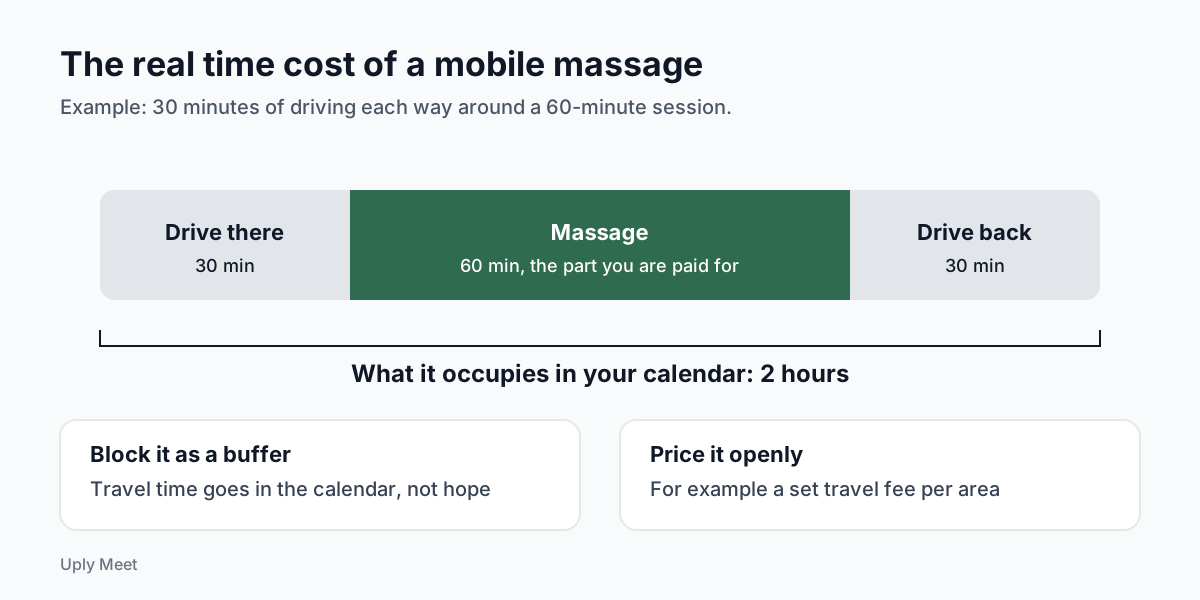
A mobile massage business goes to the client: homes, hotels, offices and events. Startup costs are lower because you carry a portable table instead of paying rent. The hidden cost is travel. If every booking needs 30 minutes of driving before and after, a 60-minute session really occupies two hours of your day. Build that travel time into your calendar as a buffer, not as a hope.
A home massage business
A home based massage therapy business keeps costs low and removes the commute, but it brings zoning, insurance and privacy questions. Check whether your local rules allow clients to visit a home treatment room, and whether your home insurance covers business visitors. Many therapists also prefer not to publish a home address on a public page, which matters when you choose how clients book.
| Model | Main fixed cost | Biggest time cost | Watch out for |
|---|---|---|---|
| Rented room or studio | Rent, every month | Gaps between bookings | Premises licence where required |
| Mobile | Car, portable table, kit | Travel before and after each visit | Personal safety, travel buffers |
| Home based | A room set aside at home | Turnaround between clients | Zoning, insurance, privacy of your address |
Our view: if you are unsure, start mobile or in a rented room for six months. You learn what clients will pay and which hours fill before you sign a long lease for your massage business.
Licences, insurance and registering the business
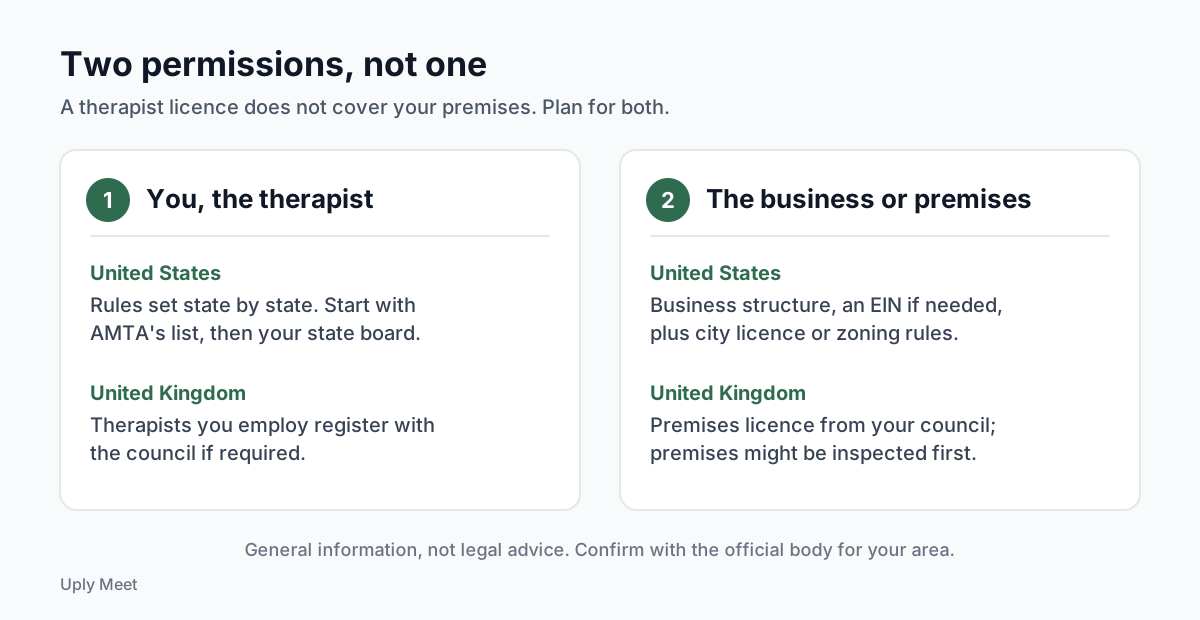
There are usually two separate permissions: one for you as a therapist and one for the business or premises. When you are opening a massage business, plan for both, because having one does not give you the other.
In the United States
Massage therapy rules are set state by state. The American Massage Therapy Association keeps a state-by-state list of "massage therapy regulation and license requirements for each state so you can practice legally." Start there, then confirm with your state board and your city, which may add its own business licence or zoning rules.
For the business itself, the US Small Business Administration explains that your structure "affects how much you pay in taxes, your ability to raise money, the paperwork you need to file, and your personal liability." If you need an Employer Identification Number, the IRS issues an EIN online for free and warns: "You never have to pay a fee for an EIN."
Setting up a massage business in the UK
GOV.UK says most businesses register as a sole trader or a limited company, and that a sole trader "is the simplest business structure to set up and keep records for." You must register for Self Assessment as a sole trader if you earn more than £1,000 in a tax year.
Premises are a separate question. GOV.UK's massage and special treatment premises licensing page tells you to contact your council for a premises licence "if you run an establishment for massage or other special treatments," notes that premises might be inspected first, and says therapists you employ "should also register with the council if required." Fees and rules differ by council, so ask yours before you sign a lease.
Insurance
Professional liability insurance covers claims that a treatment caused harm, and general liability covers accidents such as a client slipping in your room. Mobile therapists should also check that their car insurance covers business use. Get quotes before your first paid session, not after.
Set prices and a service menu that pays
New therapists often copy the price of the spa down the road. That spa has a different rent, different staff costs and a different number of treatment rooms, so its price tells you very little about yours.
Work out your price floor first
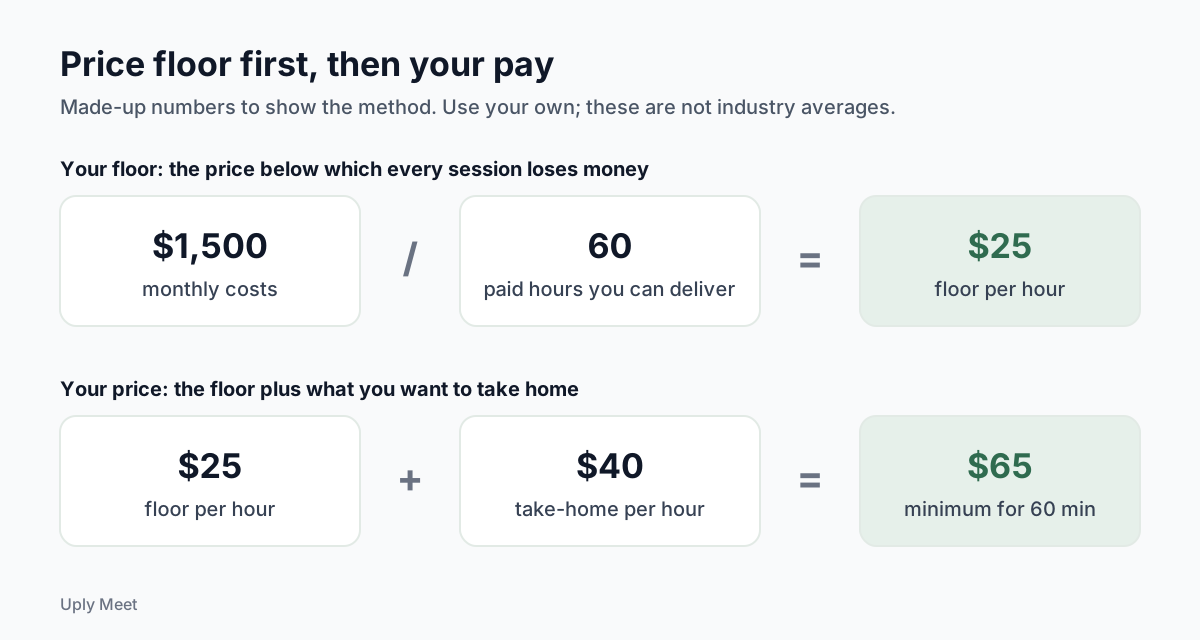
Add up a month of business costs: rent or travel, insurance, linens and oils, software, card fees and money set aside for tax. Then estimate how many paid hours you can realistically deliver, not how many you hope for. Divide costs by paid hours to get your floor, the price below which every session loses money. Then add what you want to earn per hour on top.
Keep the menu short
Three to five services is plenty to start: for example a 60-minute and a 90-minute massage, one specialty treatment and maybe a short add-on. A short menu is easier to price, easier to explain and easier for clients to choose online. Give each service its real length, including the time you need to change linens, so your calendar never promises a slot you cannot keep.
Mobile therapists should price travel openly, either as a set fee per area or as a higher price for home visits. Hiding it inside the session price works until a client books you from across town.
Booking, reminders and a cancellation policy
For a solo massage business, a missed 90-minute session is lost income, because that hour cannot be sold again. Research on this comes from healthcare, not massage studios, but the pattern is useful. A review of 105 studies found an average no-show rate of about 23% in healthcare appointment scheduling (Dantas et al., Health Policy, 2018).
A meta-analysis of clinic reminder trials, mostly text messages, found that patients who got notifications were 25% less likely to miss an appointment, and that multiple notifications worked better than a single one (Robotham et al., BMJ Open, 2016).
Massage therapists say similar things in their own words. One therapist on Reddit wrote that they had "only had a handful of no shows in 20 years," and credited sending "a reminder the day before thru email or text." That is one person's experience, not a study, but it matches the research above.
Write a cancellation policy clients can read in 30 seconds
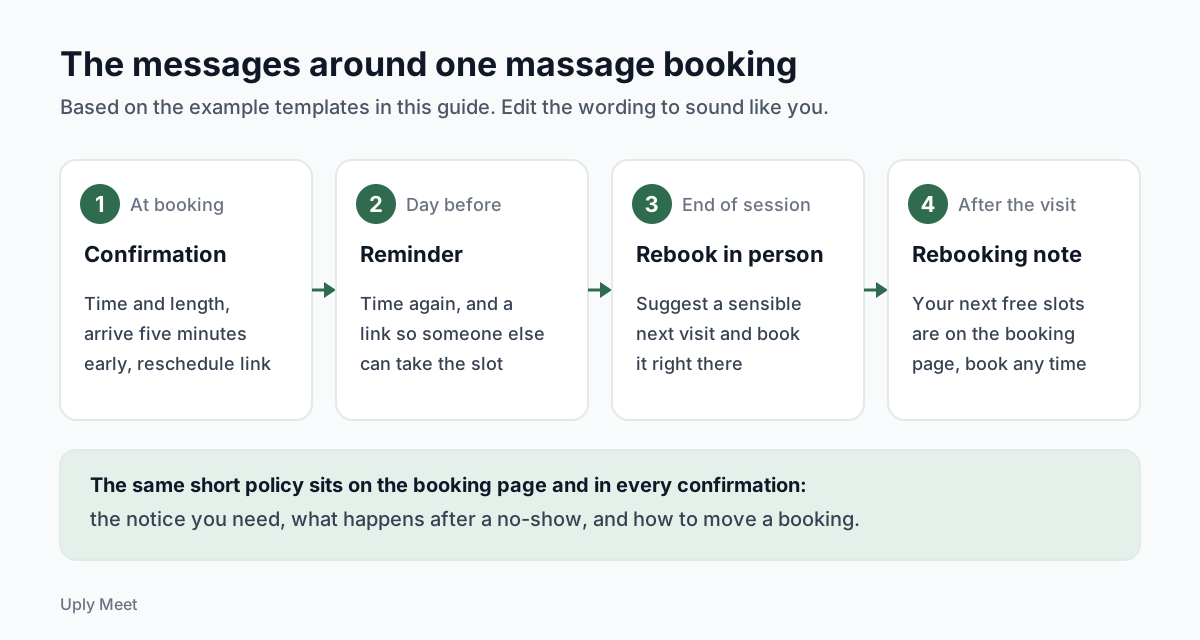
State the notice you need, what happens after a late cancellation or a no-show, and how clients can move a booking. Show it on your booking page and in every confirmation. A clear policy feels fair because the same rule applies to everyone.
Example policy (copy and edit): Please give us at least 24 hours notice if you need to cancel or reschedule. You can do it any time with the link in your confirmation email. Late cancellations and missed appointments may be charged in full. We are happy to make an exception for genuine emergencies.
Thinking about charging for missed visits? Our guide to the no show fee walks through the options.
Message templates you can copy
These are examples. Change the names, times and tone to sound like you.
Example confirmation: Hi Sam, you are booked for a 60-minute massage on Friday at 3:00 pm. Please arrive five minutes early. Need to change it? Use the reschedule link in this email. See you soon.
Example day-before reminder: Hi Sam, a quick reminder of your massage tomorrow at 3:00 pm. If your plans have changed, please reschedule with the link below so someone else can take the slot.
Example rebooking note: Thanks for coming in today, Sam. If you would like to keep the same rhythm, your next free slots are on the booking page. Book whenever suits you.
If you use a booking tool, an automatic appointment reminder by email removes the need to send these by hand. Keep health questions out of the public booking form. Under the EU GDPR (Article 9), data concerning health is a special category, so handle intake and health notes separately, in the way your local rules require.
Massage business software: what you need on day one
You do not need a full spa management suite on day one. A new massage business needs a handful of things; paying for more just adds settings to learn. Here is the short list we would check any tool against:
- A booking page clients can use without creating an account or downloading an app.
- Services with their own length and price.
- Working hours, breaks, days off and buffers between sessions (travel time for mobile work).
- Protection against two clients booking the same slot.
- Automatic email confirmations and reminders.
- A link that lets clients reschedule or cancel inside your policy, without calling you.
- A calendar you can check on your phone between sessions.
Prices vary a lot. Here are the entry prices for one person as listed on official pricing pages (US prices, checked October 25, 2026; they change, so check the links):
| Option | Entry price for one person | Worth knowing |
|---|---|---|
| Square Appointments | Square Free, $0 per month per location | Card processing fees apply, for example 2.6% + 15¢ in person |
| Fresha | Independent, $19.95 per month (US page) | 20% one-time commission on new clients from the Fresha marketplace, minimum $6 |
| Booksy | $29.99 per month plus tax | Optional Boost feature charges a one-time 30% of a new client's first visit, up to $100 |
| Vagaro | $30.00 per month for one calendar | Extra calendars cost $10 each, up to seven licences |
| Uply Meet | Free plan $0 (100 online bookings a month); Pro $12 per month | Email reminders only; deposits are coming soon |
Marketplaces can bring new clients, but you pay for them through commissions or fees. A standalone booking page brings no new clients by itself; you send people to it from your website, Google profile and messages. Neither is better for everyone. If most of your clients already come from referrals, paying a marketplace fee on them makes less sense.
If you want a tool built for exactly this list, our page on massage software shows how Uply Meet handles services, buffers, reminders and reschedule links for therapists.
Finding your first clients and keeping them
A new massage business gets most early clients from people who already know you: friends, former colleagues, the gym or clinic where you rent a room. Ask each of them directly for a referral.
Make booking the easy part
Put one booking link everywhere: your website, your Google Business Profile, your email signature and your message replies. A client who can see your free times and book in a minute does not need to wait for you to finish a session and reply. Online appointment booking also helps clients in other time zones, such as hotel guests booking a mobile session before they travel.
Rebook before they leave
Regular clients are the steadiest income in any massage therapy business. At the end of each session, suggest a sensible next visit based on what you worked on and help them book it right there, or send the rebooking note above. We think this one habit matters more than any discount campaign, because it fills next month before it starts.
A short launch checklist
- Pick your model: studio, mobile or home based.
- Confirm your therapist licence and any premises licence for your area.
- Choose a business structure and register it.
- Buy professional and general liability insurance.
- Work out your price floor and write a short service menu.
- Write your cancellation policy.
- Set up a booking page with hours, buffers and email reminders.
- Share your booking link with everyone who already knows you.
Frequently asked questions
How much does it cost to start a massage business?
It depends mostly on your model. Mobile and home based practices avoid rent but still need a table, linens, insurance and any licence fees. A rented room adds a fixed monthly cost. Add up your own monthly costs and divide by the paid hours you can realistically deliver to find the lowest price you can charge.
Do I need a licence to open a massage business?
Usually yes, and often two kinds: a licence for you as a therapist and a licence or registration for the premises. In the US, rules are set by each state. In the UK, GOV.UK says to contact your council about a massage and special treatment premises licence. Check with the official body where you work.
Is a mobile massage business a good way to start?
It is a common low-cost start because you do not pay rent. The main cost is travel time, so add buffers between bookings and price travel openly, for example as a fee per area.
What software does a massage therapy business need?
At minimum: an online booking page clients can use without an account, services with their own length and price, working hours and buffers, protection against double bookings, automatic email reminders and a link for clients to reschedule or cancel.
How do I reduce no-shows without being strict?
Publish a short cancellation policy, send reminders before each visit and give clients an easy way to reschedule. Clinic research found that more than one reminder works better than one. Deposits are another option some therapists use.
Should I copy the prices of massage spas near me?
Not as a starting point. A nearby spa has different rent, staff costs and room numbers, so its price says little about yours. Work out your price floor from your own monthly costs and realistic paid hours, then add what you want to earn per hour.
How many services should a new massage business offer?
Three to five is plenty to start, for example a 60-minute and a 90-minute massage, one specialty treatment and maybe a short add-on. A short menu is easier to price, explain and book online. Give each service its real length, including linen changes.
Should health questions go on my online booking form?
Keep them off the public booking form. Under the EU GDPR (Article 9), data concerning health is a special category, so handle intake and health notes separately, in the way your local rules require.
Sources
- US Bureau of Labor Statistics: Massage Therapists, Occupational Outlook Handbook
- AMTA: Massage therapy state regulations
- US Small Business Administration: Launch your business (choose a business structure)
- IRS: Get an employer identification number
- GOV.UK: Set up a business
- GOV.UK: Massage and special treatment premises licensing
- Regulation (EU) 2016/679 (GDPR), EUR-Lex
- Dantas et al. (2018), No-shows in appointment scheduling: a systematic literature review, Health Policy
- Robotham et al. (2016), Using digital notifications to improve attendance in clinic: systematic review and meta-analysis, BMJ Open
- Reddit r/MassageTherapists: What is your actual no-show rate
- Square Appointments pricing (checked October 25, 2026)
- Fresha pricing (US view, checked October 25, 2026)
- Booksy pricing (checked October 25, 2026)
- Vagaro pricing (checked October 25, 2026)